Board and spoon sets: the weakest item in the pack sets the compliance file
A two-piece kitchen set is sold as one SKU and tested as two articles. The declaration has to cover both, and it usually covers only the one with the logo.
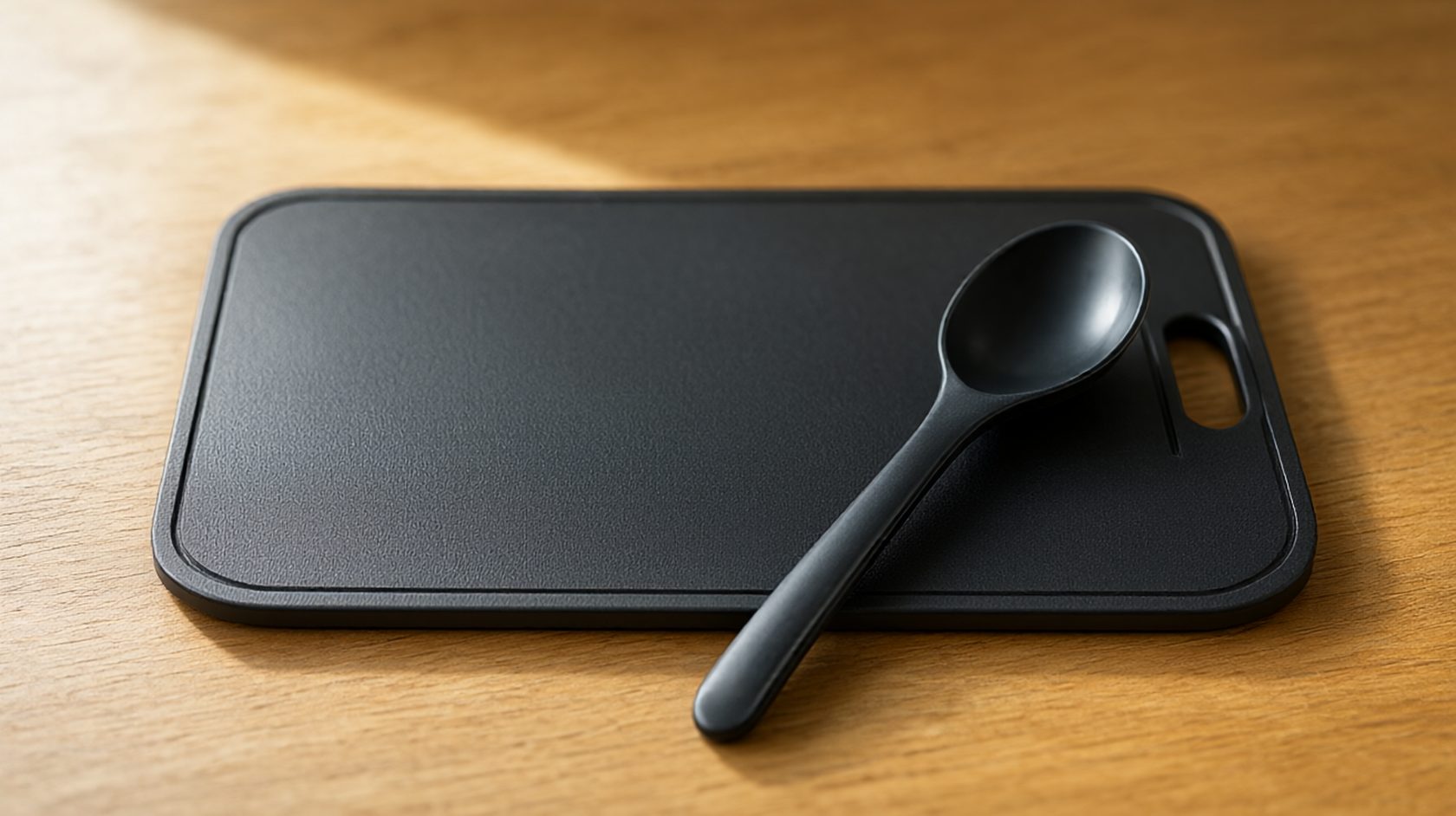
A set is a SKU, not a product
When a board and a spoon are packed together, the retail unit is one SKU with one barcode and one price. The compliance unit is still two food-contact articles with two materials and two declarations, and that gap is where a set fails an audit.
The failure is not usually a bad material. It is a missing document: the declaration covers the board, the spoon is described as an accessory, and the accessory is the article that touches hot food.
The fix is a bill of materials that lists every item in the pack with its material, its grade and its declaration reference. A set with four components needs four lines, and each line has to point to a document rather than to a supplier's name.
This is also the document that answers a retail buyer's first question, which is not the price but the file. A set with a complete file can be listed in a market that requires one; a set without it is a negotiation that ends at the compliance desk.
Material identity and the mark on the back
A plastic board and a nylon spoon both have to carry a material identification mark in most markets, and the mark has to match the resin, not the marketing name. A board marked as polypropylene that is actually a filled polyethylene is a mislabelled article.
The mark is usually a triangle with a number and letters, moulded into the back of the board and near the handle of the spoon. A pad-printed mark is acceptable in some markets and not in others, and a printed mark wears off in a dishwasher.
The mark's position matters for the same reason: a board mark under the non-slip feet is invisible to an inspector and a spoon mark inside the bowl is a hygiene problem. Both should be in a place that is legible and does not touch food.
The check is simple and often skipped: read the mark on the sample and compare it with the resin certificate. A mismatch between the moulded mark and the certificate is the single most common documentation failure in a kitchen set.
The board: warping, feet and the knife that finds the soft spot
A plastic cutting board fails in three ways: it warps, its feet fall off, and its surface cuts through. All three are process problems rather than material problems, and all three are testable.
Warping comes from moulded-in stress and from uneven cooling, and it shows as a board that rocks on a flat counter or that cups after a dishwasher cycle if it is dishwasher-safe. A board that is flat when new and cupped after ten cycles was never stress-relieved.
The feet are usually overmoulded or press-fit, and both fail at the interface rather than in the foot. A press-fit foot that pulls out at a stated load is a foot that will pull out in a kitchen, and the load is the force of a hand sliding the board across a counter.
Surface cuts are a design feature as much as a defect: a board is meant to be cut, and its life is the depth at which a knife reaches the base. The specification should state the surface thickness above the base plate, not the total thickness.
The spoon in the set is the hot item
In a board-and-spoon set the board never sees heat and the spoon sees boiling food on its first use. The heat rating of the spoon therefore sets the set's claim, and a set sold as heat resistant on the strength of the board is a claim with no basis.
The spoon in these sets is often the cheapest component, which means the lowest fill, the thinnest wall and the least heat stabiliser. A set assembled to a price is a set whose hot item is the one that was cost-reduced last.
The consequence is a spoon that deforms at the bowl edge and a customer who reports that the set melted. The board is untouched, the spoon is a set screw, and the complaint is about the set.
The specification has to rate the set at the rating of its weakest heat-exposed component, and the file has to say which component that is. A set rating without a named limiting component is a rating that cannot be defended.
Colour matching across two processes
A set is sold on visual coherence, and the two components are usually made by different processes: an injection-moulded board and an injection-moulded spoon, or a board from one supplier and a spoon from another. Colour drifts between them.
The drift is not a defect in either part; it is a mismatch. But in a pack, a mismatch is read as a cheap set, and the customer returns it as a colour problem even when both parts are within their own tolerance.
The specification should be a colour difference between the two parts, measured under a stated illuminant, rather than two separate matches to a master. A pair that is each within two units of the master can be four units apart from each other.
This is the one line in a set specification that exists only because the product is a set, and it is the line most often missing. It costs one measurement per lot and it prevents the return that no individual test would have predicted.
Packaging that survives a retail shelf
A set is packed for a shelf, so the pack has to protect two items, present one face and survive a handling chain that includes a pallet, a truck and a store room. The weak point in most sets is the joint between the two items.
A sleeve that holds the spoon against the board will rub the spoon's bowl against the board's surface, and the rubbing produces a matte patch on the spoon and a scratch on the board. A tissue interleaf or a moulded recess fixes it.
The pack also has to survive the drop that a retail carton sees, from a stated height onto a corner. A set whose spoon escapes the sleeve and lands on the board's edge arrives with a chipped spoon handle.
The pack specification should name the retention method, the interleaf, the drop height and the barcode position. The last one matters because a barcode over a curved surface scans badly and the store returns the carton.
Migration testing of a set: which simulant for which part
Migration testing a set means testing each food-contact part with the simulant that matches its use. A board sees a knife and wet vegetables; a spoon sees hot oil and boiling water. The two conditions are different and the simulants are different.
A single test on the assembled set is a test of the worst case, which sounds conservative and is usually useless, because the extraction conditions for a board and a spoon cannot both be met in one run. The result is a figure that satisfies neither.
The practical route is two tests: one on the board at an aqueous condition, one on the spoon at a fatty condition, both at the time and temperature of use. The report then covers the set with two lines rather than one average.
The file should also record the total surface area used for each test, because a migration result is an area-based figure and a set has two very different areas. A spoon tested at the board's area gives a number that means nothing.
Assembly labour and the hidden cost
A set has an assembly step that a single item does not, and the step is where the labour cost hides. A pack that needs a hand to place a spoon in a sleeve costs more per unit than a board that needs nothing.
The assembly also creates a quality gate that no incoming inspection covers: whether the right spoon went into the right pack. A mixed lot is a set with a mismatched colour and a customer complaint that reads as a quality problem.
The fix is a count check at packing and a colour check on the assembled pack, both of which are faster than unpacking a mixed carton later. A pack that is checked at assembly costs a second; a mixed carton costs a return.
For a set with more than two components the assembly step becomes the dominant cost, and it is the step most likely to be moved to a lower-cost location without the quality gate moving with it.
The claim on the box and the test behind it
A set's box carries claims: dishwasher safe, heat resistant, BPA free, food safe. Each claim should map to a test, and a set with four claims and one test has three unsubstantiated claims.
Dishwasher safe is a cycle test on both parts. Heat resistant is a deflection test on the heat-exposed part. BPA free is a statement about the resin, and it is true of a polypropylene board and meaningless for a nylon spoon unless the monomer is named.
Food safe is not a test at all; it is a conclusion drawn from a migration report and a material declaration. A box that says food safe without either document is making a claim that an authority can ask it to prove.
The useful discipline is to print one claim per test, and to keep the test report number in the file next to the artwork. That way a challenge to a claim resolves to a document rather than to a re-test.
Six documents for a two-piece set
A two-piece set needs six documents: a bill of materials with a grade per item, a material identification mark check, a migration report per food-contact part with its simulant and area, a heat rating for the limiting component, a colour difference record between the parts, and a drop test on the packed set.
Six documents for two items looks heavy, and it is the minimum that covers the four failure modes a set actually has: a wrong mark, a hot spoon, a mismatched colour, and a pack that lets the spoon escape.
The documents also make the set quotable. A supplier who can produce all six is a supplier whose price difference can be explained, and a supplier who cannot is one whose saving is in the missing test.
Keep the six with the artwork, review them when any component changes, and treat a component substitution in a set as a new SKU rather than as a cost update. A substituted spoon is a new compliance file, even if the barcode is the same.
A set whose limiting heat-exposed component is named in its file is the cutting board and nylon spoon set, and naming it is what makes the set's rating defensible.
- 01Bill of materials listing every item in the pack with its resin grade.
- 02Moulded material identification mark read and matched to the certificate.
- 03Board flatness checked new and after ten dishwasher cycles if claimed safe.
- 04Press-fit feet pull-tested at the force of a hand sliding the board.
- 05Set heat rating named to its limiting heat-exposed component, not the set average.
- 06Colour difference measured between the two parts under a stated illuminant.
- 07Two migration tests, one aqueous on the board, one fatty on the spoon, with areas recorded.
- 08Drop test on the packed set onto a corner, with the spoon checked for escape.