Colanders: hole pattern, burr side and the coating that peels from the inside
A colander is a bowl with several hundred holes punched through a curved wall. The holes decide the drain time, the burr decides the cleaning, and the coating decides the first complaint.
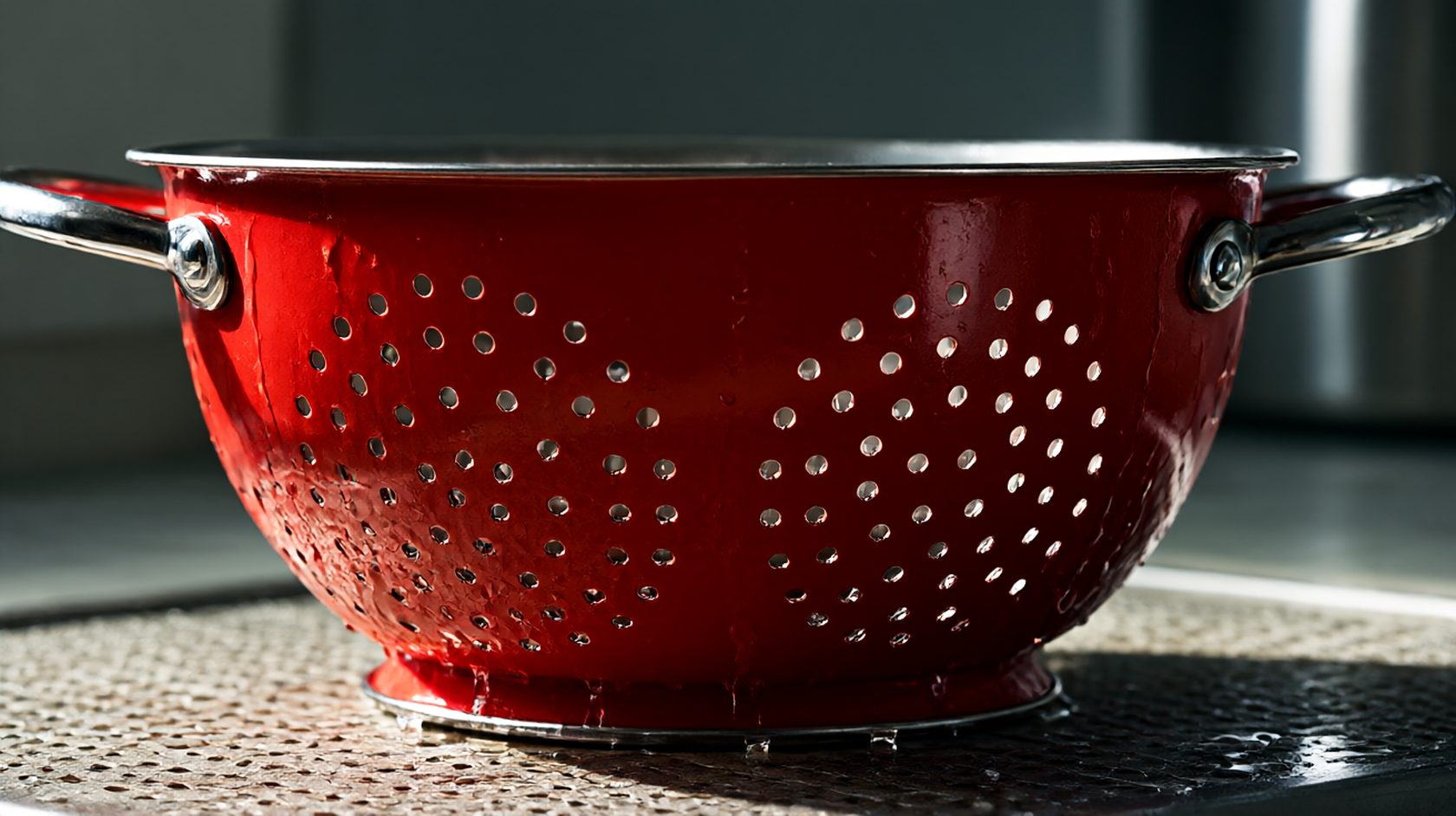
Hole pattern as a flow calculation
The drain rate of a colander is set by the total open area, not by the number of holes. Two colanders with the same hole count and different diameters can differ by half in flow, because open area goes with the square of the diameter.
The practical figure is open area as a percentage of the bowl's projected area. A pasta colander usually runs between eight and twelve per cent; a colander for rinsing greens runs higher, because the load is lighter and the water has to leave faster.
The distribution matters as much as the total. Holes concentrated at the base drain quickly and leave the upper wall wet; holes spread evenly drain more slowly but empty the whole surface, which is what a rinse actually needs.
A purchase order that specifies a hole count without a diameter or a distribution is specifying a look. The useful line is the open-area percentage with a hole diameter and a stated distribution band.
Punch direction and the burr you cannot see
Holes are punched, and the punch leaves a burr on the side the material exits. If the punch comes from the outside in, the burr is on the inside of the bowl, which is the side the food touches and the side a sponge cannot reach.
A burr on the food-contact side is a hygiene defect before it is a cosmetic one. It holds food residue, it cuts a cloth, and it is the place where a coating will not cover, which is why coated colanders fail first at the holes.
The correct direction is punch from the inside out, or punch and then deburr from the inside with a reaming pass. Both leave a rounded edge on the food side and a slight burr on the outside, which is acceptable because the outside is washed by flow.
The check is a finger rub on the inside of a random hole field, plus a visual under a low raking light. A gloved finger catching on a hole edge is a reject, and it is the fastest test on the line.
Coating adhesion: the holes are the weak points
A coloured colander is usually coated by powder or by a liquid enamel over a grit-blasted surface, and the coating is thin at every hole edge because the film cannot build over an edge. The hole field is therefore a map of the coating's weak points.
Adhesion is tested by a cross-hatch or by a bend, and both should be run on a coated panel that includes holes rather than on a flat coupon. A flat coupon passes; the same coating over a punched edge fails at the edge.
The failure mode is a chip that starts at a hole and spreads along the bowl wall as a blister. Once the coating lifts, water sits under it and the steel beneath corrodes, which shows as a rust stain through the colour.
The specification should require a tape-pull after cross-hatch at a stated adhesion grade, on a holed panel, after a dishwasher cycle. That sequence catches both the initial adhesion and the loss of it under detergent.
Handle welds on a thin curved wall
A colander handle is a loop or a pair of ears welded to a thin curved wall, and the weld is the joint that carries a full load of wet food. The wall at the weld is the thinnest part of the bowl because the draw thinned it, so the weld sits on the weakest section.
The common failure is a plug failure: the weld is stronger than the wall, so the load pulls a disc of wall out and leaves a hole. A handle that was pull-tested to a high load on a thick sample will fail on a production bowl for exactly this reason.
The correct test is a pull on the handle at the rated load, applied at the handle end, on a bowl filled to capacity. The pass criterion is no deformation of the bowl wall and no crack at the weld toe after the load is removed.
If the handle must be welded rather than riveted, the wall at the weld should be locally thickened or the weld should be a lap rather than a plug. Both are tooling decisions and both are cheaper than a recall.
The red that is not the same red in every lot
A coloured coating is matched to a master panel, and the match drifts with the pigment lot, the film thickness and the cure. A red that reads correctly on a thick film turns orange on a thin one over a curved surface.
Film thickness over a curved wall varies because the spray or the powder cloud reaches the equator differently from the poles. A colander with a visible colour shift from rim to base has a thickness gradient, not a pigment problem.
The measurable specification is colour difference against a master under a stated illuminant, plus a minimum film thickness at the rim, the equator and the base. Both are needed, because either one alone can pass while the other fails.
Colour also changes with cure. An undercured film is softer, adheres worse and shifts lighter after a dishwasher cycle; an overcured film is brittle and chips at the holes. The cure window is narrow and it belongs in the process sheet.
Salt spray and the scribed edge
A salt spray result on a coated colander is meaningful only if the panel is scribed through the coating to the steel. An unscribed panel tests the coating; a scribed panel tests the system, which is what a chipped product in service actually is.
The usual criterion is no blister beyond two millimetres from the scribe after a stated number of hours, with no rust creep along the scribe. A coated panel that passes unscribed and fails scribed is a coating that protects until it is damaged.
Holes should be included in the scribed area, because the hole edge is where the film is thinnest and where damage starts. A panel with a scribe through a hole field is the closest laboratory analogue of the product.
The hours should match the market: a colander sold into a coastal market needs a longer figure than one sold inland, and a colander that is dishwasher-washed needs a detergent pre-conditioning before the spray.
Drain time as an acceptance test
Drain time is the simplest functional test a colander has, and it is usually not written down. Fill the bowl with a stated volume of water, lift it clear of the surface, and time until the flow stops.
A drain time that is too long means the open area is low or the holes are partly blocked by burrs. A drain time that is too short usually means a large hole field at the base and a bowl that leaves the upper wall wet.
The test is also a check on hole consistency, because a field with a few blocked holes drains noticeably slower than one with none. A single blocked hole in a two-hundred-hole field is hard to see and easy to time.
The useful acceptance criterion is a drain time band for a stated volume, plus a check that no hole in a random sample of twenty is blocked. Both are line tests that take under a minute.
Shape stability under a full load
A colander full of wet pasta is a bowl carrying several kilos on a wall that was drawn thin, held by a handle welded to that wall. The shape under load is the product's real strength test, and it is rarely specified.
The failure is an ovalisation of the rim under load, which does not break anything but makes the colander sit badly in a sink and jam in a pot. A rim that is oval by four millimetres under load and stays oval is a permanent deformation.
Rim stiffness comes from a rolled rim, a flared rim or a bead, and all three cost a forming step. A plain rim on a large colander is a rim that will ovalise, and no amount of coating hides it.
The test is a load equal to the rated capacity of wet food, held for a minute, with the rim diameter measured before and after. A permanent change over one millimetre is a reject for a product that will be used weekly.
Foot ring, sink fit and the diameter that matters
A colander either stands on a foot ring or sits on a sink rim, and both depend on a diameter that is stated on the drawing but rarely measured at the dock. A colander that does not fit the sink it was designed for is returned as the wrong size.
The foot ring has to be wide enough to be stable when the bowl is full and narrow enough not to trap water. A ring under fifty per cent of the base diameter will tip under a full load; a ring that is nearly the full base traps water and corrodes.
For a sink-fitting colander the relevant dimension is the outer diameter at the height where it rests, which is usually not the rim diameter. A drawing that gives only the rim diameter leaves the fit undefined.
The check is to place the colander in the sink it is specified for and rock it. A colander that rocks on the sink rim has a contact diameter that is out of tolerance, and it will spill when the sink is used.
Packing a thin shell: the dent that arrives
A colander is a thin shell with a handle that sticks out, so its carton has to protect a curved surface and a lever at the same time. A carton that lets the handle take the drop will deliver a colander with a cracked weld.
The usual protection is a moulded pulp or a corrugated cradle that holds the bowl by the rim and leaves the handle free. A carton that grips the handle transfers the drop straight into the weld.
The drop sequence should be on the base, on the side and on the handle end, from the height the carton will see. A colander that dents at the base and stays sound has passed; one that cracks at the handle root has failed, and the two failures have different causes.
Cosmetic damage is the more common outcome, and a dent at the equator is visible on a coated product even when the coating is intact. The dent limit should be stated in millimetres, not as a judgement.
What a colander drawing needs
A colander drawing needs six numbers and two processes: hole diameter, hole pitch, open-area percentage, distribution band, rim form, contact diameter, plus the punch direction and the coating sequence with its cure window.
Six numbers cover the function; two processes cover the failures that no dimension catches, which are the burr on the food side and the adhesion at the hole edge. Those two are the defects that come back from a customer rather than from an inspector.
The drawing should also carry the drain-time band and the load-ovalisation limit, because those are the two tests that describe how the product behaves rather than how it measures. Both are cheap and both are repeatable.
Write them, keep one reference colander per coating lot, and re-qualify when the hole pattern, the punch direction or the coating supplier changes. All three move the two process numbers at once.
The colander whose open area is given as a percentage is the red colander, and the percentage is the figure a drain time can be predicted from.
- 01Open area as a percentage of projected area, with hole diameter and pitch.
- 02Hole distribution band stated; holes not concentrated at the base.
- 03Punch direction from the inside out, or a reaming pass on the food side.
- 04Finger rub on the inside hole field; no edge catches a glove.
- 05Cross-hatch tape pull at a stated grade on a holed panel, after a dishwasher cycle.
- 06Colour difference against a master plus minimum film thickness at rim, equator and base.
- 07Scribed salt spray through a hole field, with the hours matched to the market.
- 08Load ovalisation: rim diameter measured before and after a full wet load.