Nylon spoons: the glass fill that makes them stiff and the heat that makes them fail
Two nylon spoons that look identical can differ by forty degrees in service temperature. The difference is in the resin, not in the shape.
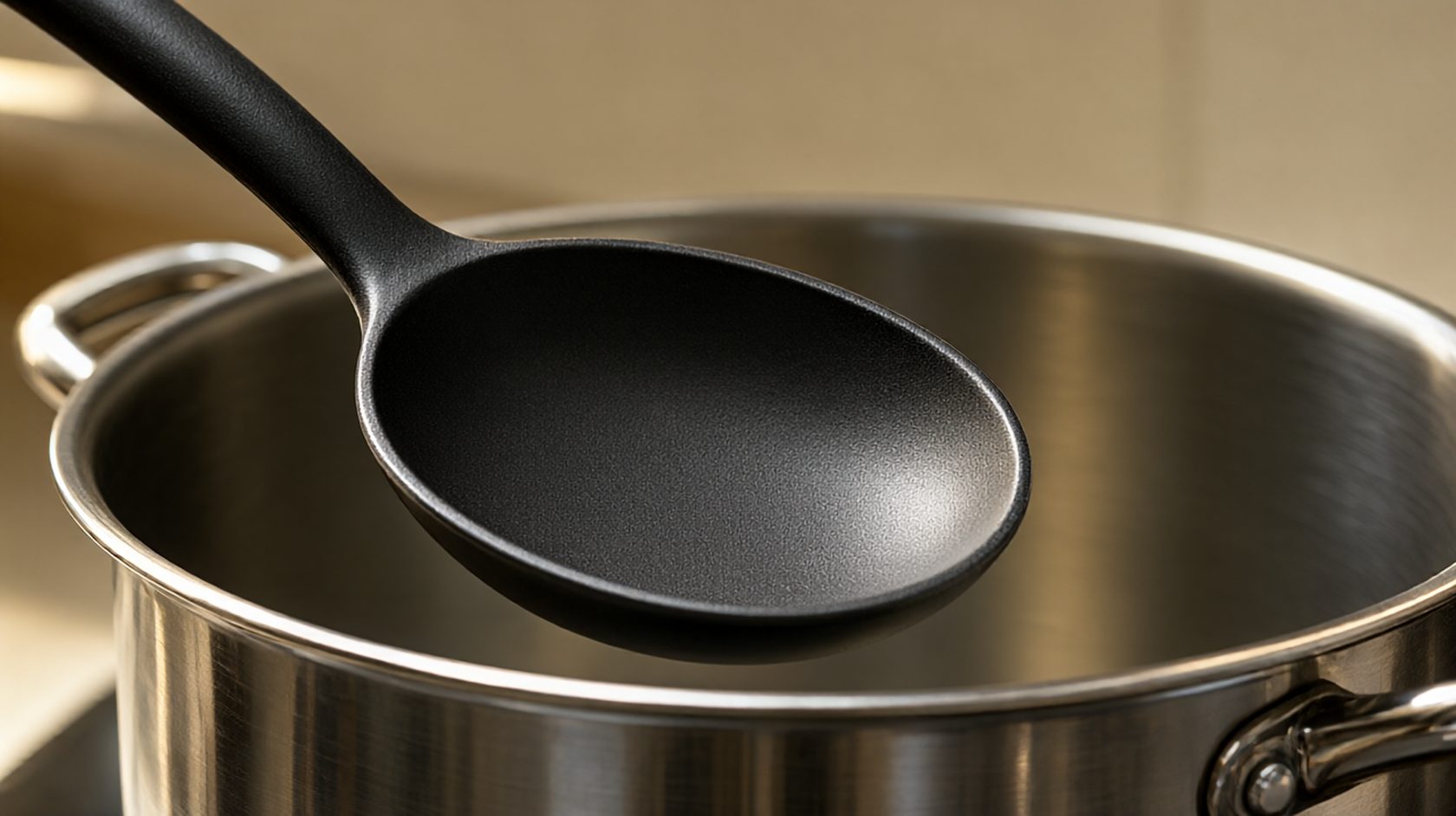
PA6 and PA66 are not the same spoon
Nylon kitchen tools are made from PA6, PA66 or a blend, and the three differ in melting point, water uptake and stiffness. PA66 melts around 260 degrees; PA6 around 220. The service temperature follows the melting point by a wide margin.
A PA6 spoon that is rated to 200 degrees is a spoon on the edge of its capability, because the rating is a short-term figure and the crystallinity that supports it degrades with every hot cycle. A PA66 spoon at the same rating has margin.
The difference is invisible in the hand and identical on a photograph, so the resin has to be specified rather than described. A purchase order that says nylon has specified a family, not a material.
The incoming check is a differential scanning calorimetry curve or, more practically, a melt-flow index and a density. Neither is a shop-floor test, so the specification has to rely on the supplier's certificate plus a periodic third-party check.
Glass fill: stiffness, and the surface it changes
Most cooking spoons are glass-filled, usually at fifteen to thirty per cent, because the fill raises stiffness and heat deflection temperature at the same wall thickness. It also changes the surface from glossy to matte.
The fill content is what a buyer is actually paying for when a spoon is sold as heat resistant, and the content is what a certificate states and what a burn-out test measures. A fifteen per cent spoon sold as thirty per cent is a common substitution.
Glass fill has a cost beyond stiffness: it makes the resin more abrasive to the tool, more brittle at low temperature and more likely to show flow lines. A high-fill spoon that is dropped on a tile in winter can crack where a low-fill one dents.
The specification should state the fill percentage and the test method, because a burn-out result of twenty-two per cent against a nominal twenty-five is a pass at most tolerances and a fail at a tight one.
Heat deflection and the boil that is not a boil
A spoon that is rated to 200 degrees is tested in an oven or in oil, not in boiling water, and the two stresses are different. Oil at 200 degrees is a dry heat; boiling water is 100 degrees with steam and detergent.
The failure in service is rarely a melt. It is a deformation: a spoon left in a pot against the wall takes a set, and the set is permanent because the polymer relaxes above its glass transition under load.
The relevant test is a loaded deflection at a stated temperature for a stated time, with the spoon held as it would be in a pot. A spoon that bends under its own weight at 120 degrees has no business carrying a 200 degree rating.
The rating should be written as a temperature with a duration and a load, or not written at all. A bare number is a marketing claim that no test supports.
Migration, odour and the food-contact file
A nylon spoon is a food-contact article, so it needs a migration test against the fat and aqueous simulants of the target market, at the time and temperature the product will actually see. Aqueous simulant at 100 degrees for two hours is the usual starting condition.
The test result is a total migration figure plus a specific one for caprolactam, which is the PA6 monomer and the substance most likely to exceed a limit. A PA66 spoon has a different monomer and a different limit, which is why the resin matters to the compliance file.
Odour is a separate failure that no migration test catches. A spoon that smells of amine after a dishwasher cycle has residual monomer or a degraded additive, and the customer reads it as a bad material even when the migration passes.
The compliance file should carry the resin grade, the fill, the migration report with its simulant and conditions, and the declaration of compliance for the target market. Four documents, and the grade is the one that ties them together.
Dishwasher cycles and the surface that chalks
A dishwasher is the hardest environment a kitchen tool sees: alkaline detergent, sixty-five degrees, a long wet dwell and a dry phase. Nylon absorbs water in that cycle and releases it in the dry phase, and the release is what chalks the surface.
Chalking is a surface deposit of degraded polymer and additive, and it appears first at the edge of the tool where the flow orientation is least favourable. A chalked spoon looks old and feels rough, and the roughness then holds food.
The qualification is typically fifty or a hundred cycles with a stated detergent, checking for chalking, colour shift, warping and loss of stiffness. A spoon that passes at twenty cycles and chalks at fifty has been qualified for the wrong life.
Heat stabilisers extend the cycle life, and their presence is usually invisible. A supplier who changes the stabiliser package to save cost produces a spoon that passes the same incoming tests and fails the same fifty-cycle test.
Colour, masterbatch and the lot that reads pink
Coloured nylon is produced with a masterbatch, and the masterbatch carrier has to match the base resin or the dispersion fails. A masterbatch on a PA6 carrier in a PA66 base gives streaks and a colour that shifts with shear.
Colour shift in nylon is also a processing signal: an overheated melt yellows, and a yellowed spoon under a white masterbatch reads cream. The shift is visible before any functional failure, which makes colour a useful early indicator.
The specification should state the colour against a master panel under a stated illuminant, and should state the masterbatch carrier. Both are cheap lines on a drawing and both prevent the lot that is functionally correct and visually wrong.
Colour fastness to washing is a separate figure, because a masterbatch that passes the colour match can still migrate into the wash water. A dyed spoon that bleeds into a dishwasher is a complaint that arrives with photographs.
Tool marks, flash and the seam at the bowl
A spoon is moulded in a two-plate tool with a gate at one end, and the gate leaves a mark that has to be trimmed. A gate trimmed flush is invisible; one trimmed with a knife leaves a step that catches a cloth and a finger.
Flash at the parting line is the other cosmetic defect, and on a thin section it is also a functional one, because flash at the bowl edge is a sharp fin that can cut. A flash limit of 0.1 mm is normal and a 0.3 mm fin is a reject.
The gate position also decides the flow pattern and therefore the weld line, which on a spoon usually lands at the bowl end opposite the gate. A weld line in a glass-filled resin is a weak line, and a spoon that breaks at the bowl has broken at its weld line.
The drawing should carry the gate location and the weld-line limit, because those two decide where the spoon breaks. Moving a gate to fix a cosmetic mark can move the break to a worse place.
Stiffness in the hand versus stiffness in the pot
A spoon has to be stiff enough to stir a thick mixture and flexible enough not to scratch a coated pan. Those two requirements pull in opposite directions, and the fill percentage is the dial between them.
A high-fill spoon is stiff and scratches; a low-fill spoon is softer and wears at the edge. The usual compromise is a low-fill bowl with a high-fill handle, made by co-injection or by a geometry change rather than by a single resin.
The service failure that matters is the bowl edge wearing into a sharp lip after months of stirring, because a sharp nylon edge scratches a non-stick coating. Edge wear is accelerated by fill, since glass particles at the surface abrade the pan and the spoon.
The test is a simulated stirring run against an abrasive surface, with the edge radius measured before and after. A spoon whose edge radius drops below a stated figure has become a scraper, whatever its datasheet says.
The handle that snaps at the joint
Many nylon tools have a handle of a different material or a different fill, joined by a mechanical interlock or by overmoulding. The joint is the weakest section and the place where a snap occurs.
An overmoulded joint fails by delamination between the two polymers, which starts as a white line at the interface and ends as a handle that separates under load. A mechanical interlock fails by shearing the pins.
The pull test should be at the joint, at the rated load, after a dishwasher cycle, because the interface weakens with heat and water. A joint that passes dry and fails wet is the standard outcome of testing in the wrong state.
The design rule is to keep the load path inside one material wherever possible, and to use the second material for grip rather than for structure. A grip that carries load is a grip that will eventually separate.
Six lines for a nylon tool
Six lines carry a nylon kitchen tool: the resin family with its grade, the glass fill percentage with its test method, the heat rating with duration and load, the migration report with simulant and conditions, the cycle count with detergent, and the edge-wear limit.
Each line names a test that can be repeated, and together they cover the four failure modes that produce returns: a spoon that deforms in a hot pot, a spoon that chalks in a dishwasher, a spoon that smells, and a spoon that wears into a scraper.
The lines that are usually absent are the heat rating's duration and the cycle count, and those are the two that turn a claim into a specification. A number without a condition is a number that a supplier can meet any way it likes.
Write the six, keep a reference tool from each resin lot, and re-qualify when the resin grade, the fill or the masterbatch changes. All three move the six at once, which is why they are the three a buyer must be told about.
The spoon whose resin grade and fill percentage are on the drawing is the nylon spoon, and the two together are what a temperature rating rests on.
- 01Resin family and grade named, PA6 or PA66, not “nylon”.
- 02Glass fill percentage stated with a burn-out test method and tolerance.
- 03Heat rating written with a temperature, a duration and a load.
- 04Loaded deflection test at a stated temperature, spoon held as in a pot.
- 05Migration report with simulant, time and temperature; caprolactam specific limit.
- 06Cycle count with the detergent named, checking chalk, colour, warp and stiffness.
- 07Colour against a master panel plus the masterbatch carrier.
- 08Edge wear: radius measured before and after a stirring run on an abrasive surface.