Small bowls: stack taper, mirror polish and the dishwasher that dulls both
A bowl is a shallow draw and a large polished area, and those two facts set its failure modes: the stack that jams and the surface that goes dull.
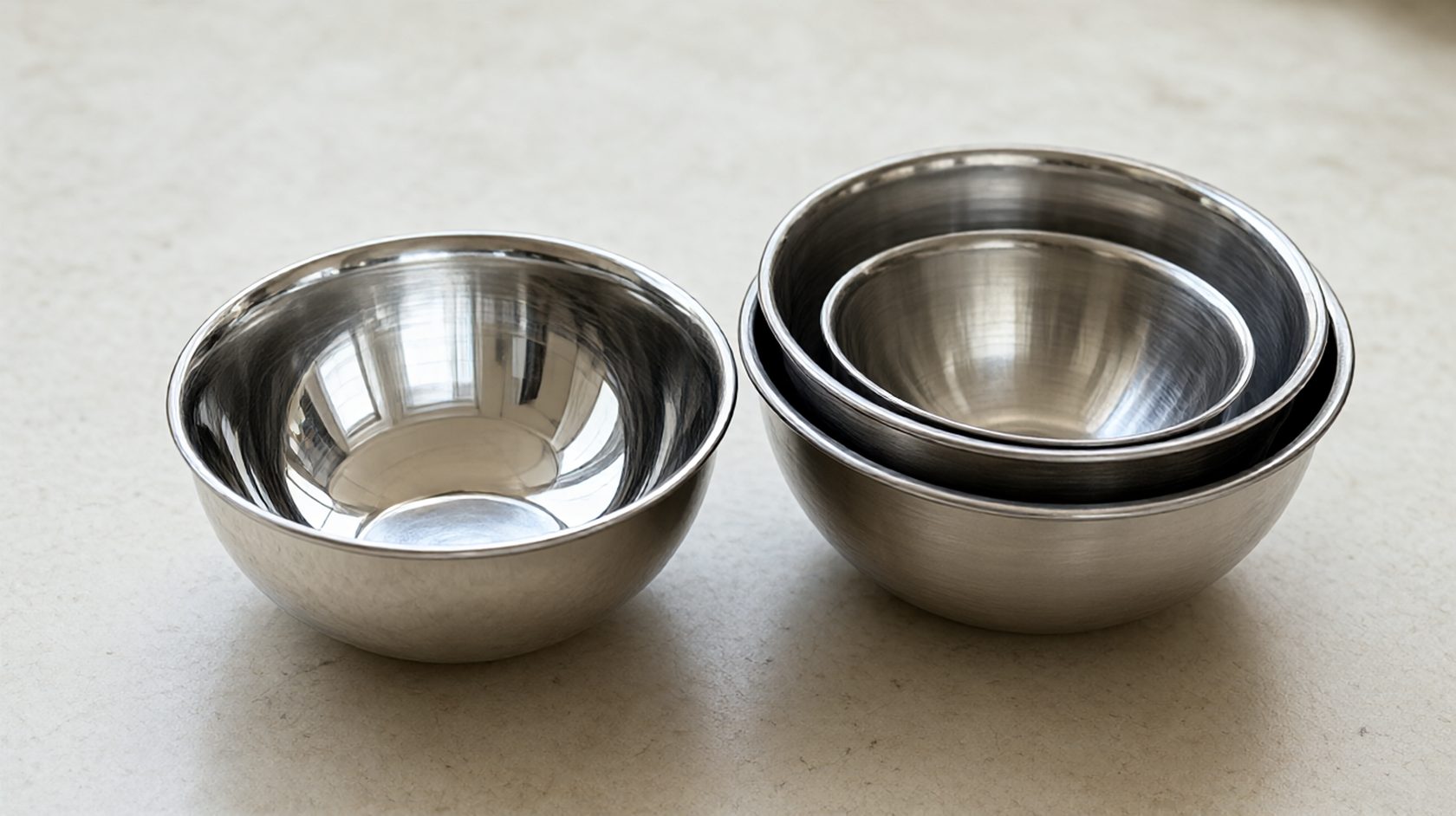
The shallow draw and the wide polish
A small bowl is the easiest form to draw and the hardest to finish, because the polished area is large relative to the material and every polish pass removes thickness from a wall that started thin. The draw costs little; the finish costs most of the unit.
The result is a bowl whose price is set by the polishing line rather than by the steel, and whose quality is set by how much material the polisher removed. A bowl that has been polished twice to remove a defect has a wall thinner than the drawing asks for.
This is why a bowl specification should start from a minimum wall after polish rather than from a blank gauge. The blank is chosen to leave the minimum, and the polisher's removal is then a process parameter to be controlled, not an invisible step.
The measurement is the same as on a cup: an ultrasonic or ball micrometer reading at four points on the wall and one at the base. A bowl at 0.35 mm after polish on a 0.6 mm blank has lost forty per cent of its section to the buff.
Stack taper: the angle that jams or the angle that leans
Bowls stack by nesting, and the nest is a cone-on-cone contact that is stable only within a narrow range of taper. Too little taper and the bowls jam; too much and the stack is tall and unstable.
The usable range for a typical small bowl is a wall slope of eight to twelve degrees from vertical. Below eight degrees the bowls bind on the second or third unit, because the contact becomes a line rather than a surface and any ovality locks it.
Ovality is the hidden variable. A bowl that is round to within a millimetre nests fine; a bowl that is oval by two millimetres will nest in one orientation and jam in the other, which reads in a warehouse as an inconsistent product.
The check is to nest ten bowls, rotate each by forty-five degrees before nesting, and see whether the stack height stays within tolerance. A stack that grows by more than a bowl's wall thickness over ten units has an ovality or taper problem.
Mirror polish: the sequence, not the shine
A mirror finish is produced by a sequence of abrasives that steps down in grit, and each step has to remove the scratches of the previous one. A bowl that jumps a grit keeps the deeper scratches and polishes the surface between them, which reads as a shine with a visible grain.
The sequence for stainless is typically a coarse sisal mop, a medium cotton mop, and a fine colour mop, with a compound matched to each. Skipping the medium step is the most common shortcut, and its signature is a surface that looks bright under a shelf light and grey under daylight.
Polishing also work-hardens the surface, which raises its strength locally and lowers its corrosion resistance by disturbing the passive film. A heavily polished bowl needs passivation after polishing, or its first dishwasher cycle will show a dull patch where the film failed.
The specification should name the grit sequence and the final Ra rather than the word mirror. Ra 0.1 on a bowl is a true mirror; Ra 0.4 is a bright satin that most buyers accept and most suppliers call mirror.
Dishwasher cycles and the dull patch
A dishwasher exposes a polished bowl to alkaline detergent at sixty-five degrees with a steam phase, and the polished surface is the most sensitive part of the product. The dull patch that appears after twenty cycles is a corrosion film, not a scratch.
The film forms first at the rim and at the base ring, where water sits, and then spreads across the polished wall as a haze. Once it is there, polishing removes it and the next twenty cycles bring it back, which is the loop that generates returns.
The cause is usually an incompletely passivated surface, sometimes combined with a detergent that is harsher than the qualification used. Nitric or citric passivation after the final polish is what separates a bowl that survives two hundred cycles from one that hazes at twenty.
The qualification test should be written with the detergent and the temperature, because a bowl that passes with a mild detergent and fails with a commercial one has not been qualified for the market it is sold into.
Rim form: rolled, flared or plain
A bowl rim is rolled, flared or left plain, and the choice decides how the bowl feels, how it stacks and how it fails. A plain rim on a 0.4 mm wall is a sharp edge that chips the polish and cuts the thumb.
A rolled rim adds stiffness and a safe edge, and it costs a roll operation and a place for water to sit if the roll is not closed. A flared rim gives a wide lip that pours well and stacks badly, because the flare is the contact surface.
The rolled rim's closure is the figure to check: a roll that leaves a gap holds water and detergent, and the gap is a corrosion cell at the thinnest part of the bowl. A feeler check at the roll is the same test as on a cup rim.
For a bowl that is used for food service rather than retail, the flared rim is often the better choice because it is easier to clean and does not trap water. For retail stacking, the rolled and closed rim is the safer one.
Base contact: the ring, the recess and the wobble
A bowl's base is a recessed disc with a contact ring, and the ring is what the bowl stands on. A ring that is too narrow rocks; a ring that is too wide traps water under the recess and corrodes from the inside out.
The usual ring is between fifty-five and seventy per cent of the base diameter, with the recess deep enough to clear a tile grout line. A recess shallower than half a millimetre is a recess that does not do its job.
Wobble on a flat surface is measured with a feeler under the rim of the base while the bowl is pressed at the opposite point. A 0.3 mm feeler entering at two opposed points is a dished base, and a dished base is a bowl that spills.
The base is also the slowest part of the draw to form and the first part to show a wrinkle. A wrinkle at the base ring is a draw defect that polishing will not remove, and it is visible as a shadow line in a mirror finish.
Diameter and volume tolerance across a cavity set
A bowl is sold as a size, and the size is a diameter and a volume. Both vary across a multi-cavity tool, and the variation is what a retail buyer notices when two bowls from the same carton do not stack.
Diameter tolerance on a small bowl is usually plus or minus 0.8 mm, and volume tolerance is usually plus or minus three per cent. A cavity set that spans more than that has a die wear pattern that needs to be mapped rather than averaged.
The mapping is simple: five bowls from each cavity, measured at the rim in two directions and filled gravimetrically. A cavity that sits at the edge of the band will drift out of it as the die wears, and it should be flagged before the lot ships.
Volume is the more sensitive of the two, because a three per cent spread on a small bowl is visible as a fill line difference when two bowls sit side by side. Diameter spread is visible only in a stack.
Etching, marking and the base that reads through
A bowl is often marked on the base with a grade, a capacity or a brand, and the mark is applied by laser or by electropolymer. Both leave a surface that is rougher than the polished field, and both are corrosion sites if they are not passivated afterward.
A laser mark through a mirror finish is visible as a matte rectangle from the inside of the bowl when the wall is thin, because the mark removes material and changes the reflectivity. On a 0.35 mm wall the mark is legible from the other side.
This is a design constraint rather than a defect: a thin bowl cannot carry a large base mark without it showing through. The options are a smaller mark, a mark on the rim, or a thicker base.
The marking also has to survive the dishwasher. An electropolymer mark fades; a laser mark survives. For a product sold into a market that requires a grade mark, the laser is the one that stays legible through the warranty.
Packing a stack: interleaf, sleeve and the carton that decides the marks
Bowls are packed in stacks, and the stack is where most cosmetic damage happens. A stack without interleaf transfers the polish of one bowl onto the rim of the next, and the transfer shows as a ring of fine scratches.
A tissue interleaf costs a fraction of a cent and removes the ring. A moulded pulp tray costs more and also fixes the count and the orientation, which is what a retail carton needs for a consistent shelf presentation.
The carton itself has to resist compression, because a stack of bowls is a column that goes out of round under load. A carton that bulges in the middle lets the stack lean, and a leaning stack loads the rims.
The packing specification should name the interleaf, the stack count, the carton compression grade and the drop height. Those four are what determine whether the bowl arrives with the polish it left with.
The bowl specification: five numbers and one sequence
Five numbers describe a bowl well enough to inspect it: minimum wall after polish, rim roll closure, contact ring diameter, rim diameter tolerance, and volume tolerance. One sequence describes the finish: the grit steps and the final Ra.
The five numbers are cheap to measure and together they catch the defects that produce returns: a thin wall from over-polishing, an open roll that traps water, a narrow ring that rocks, a cavity spread that jams a stack, and a volume spread that looks like a fill error.
The sequence catches the defect that no number catches: a surface that shines and hazes. Naming the grit steps and the passivation step makes the finish a process, and a process can be audited.
Write the five and the one, keep a reference bowl from each cavity, and re-qualify when the polish line, the blank gauge or the rim form changes. Those three are the changes that move all six.
A bowl that names its minimum wall after polish is the small spiral bowl, and that figure is the one a polishing line cannot argue with.
- 01Minimum wall after polish stated; ultrasonic or ball micrometer at four points.
- 02Wall slope between eight and twelve degrees from vertical for nesting.
- 03Ovality checked by nesting ten bowls with a forty-five degree rotation between units.
- 04Rim roll closed; no gap a 0.05 mm feeler can enter.
- 05Contact ring between fifty-five and seventy per cent of base diameter.
- 06Polish grit sequence named with a final Ra figure, then passivated.
- 07Dishwasher qualification with the detergent and temperature of the target market.
- 08Cavity map: five bowls per cavity, rim diameter in two directions and gravimetric volume.